


Products


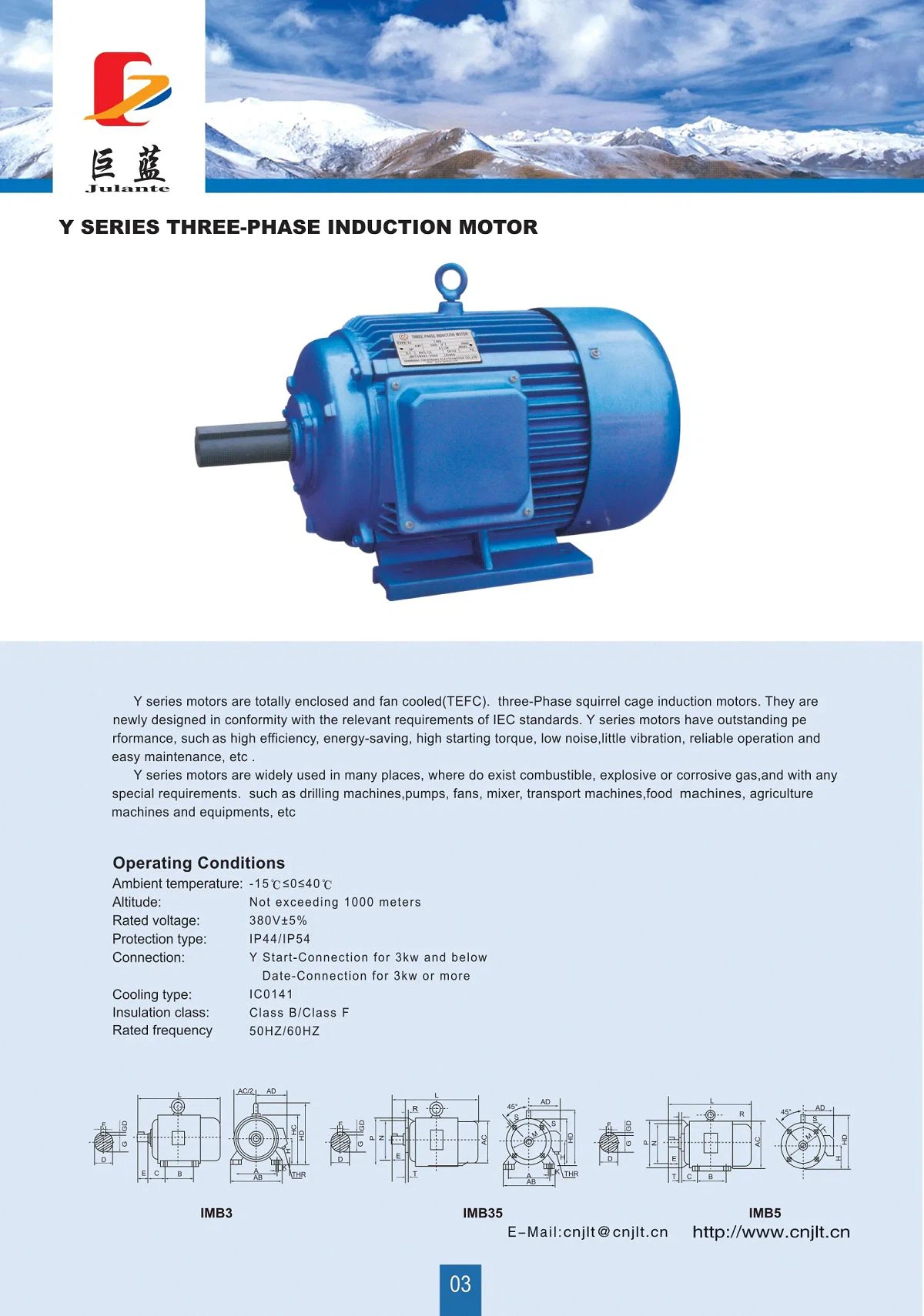
10hp Three-phase Electric Motor
Cooling type:IC0141
Protection class:IP54/IP55
Apply machines and equipments:drilling machines ,blowers , pumps and so on
Duty:S1
Features
Essential details
| Warranty:3months-1year Place of Origin:Zhejiang, China Brand Name:Julante Model Number:YE2 Type:Induction Motor Frequency:50HZ Phase:Three-phase Protect Feature:Totally Enclosed AC Voltage:380V Efficiency:IE 2 |
Cooling type:IC0141 Protection class:IP54/IP55 Apply machines and equipments:drilling machines ,blowers , pumps and so on Duty:S1 Brand:Julante and OEM Color:blue /yellow/red/customize Altitude:not exceeding 1000m Ambitent temperature:-15℃≤0≤40℃ Insulation class:B/F Certification:CCC CE |
Supply Ability
Supply Ability:10000 Piece/Pieces per Month electric motor 35kw
Packaging & delivery
Packaging Details:Carton or plywood cases
Port:ningbo shanghai guangzhou yiwu
Lead time:
| Quantity(pieces) | 1 - 30 | >30 |
| Lead time (days) | 15 | To be negotiated |
Product Overview
Three Phase Motor 3 Phase Ac Induction Motor is made of high quality cast iron.With optimized construction design,they can ensure the requirement
of structure rigidity and intensity.Silicon steel plate is used in stator core and rotor core,it has good insulation on surface,low loss which ensures the higher efficiency.High quality insulation material combines the perfect insulation system which makes the insulation completely without clearance,high rigidity of the winding end,it can endure switching and reversing intensity,F class insulation makes the motor with higher heat stability and longer life.
FEATURES AT A GLANCE
We use die-casting technology to ensure the stable quality of the rotor and aesthetic appearance.
The design of bearing and motor construction focuses on motor type,force on the motor,speed,lubricate type,including bearing,design of oil sea and lubricant etc.It has the advantage of credible performance and easy maintenance.For the frame size from 250 and below,we generally use closed bearing;frame size above 250 we use open type.Bearing.Regreasing can be done during running.Perfect primer ensures the motors with good apperance and the motors are durable.We can also use special corrosion protection coating.


Right elevation

Left elevation

Front elevation


PRODUCT SPECIFICATIONS
|
No
|
Item
|
Data
|
|
1
|
Brand Name
|
Julante
|
|
2
|
Power
|
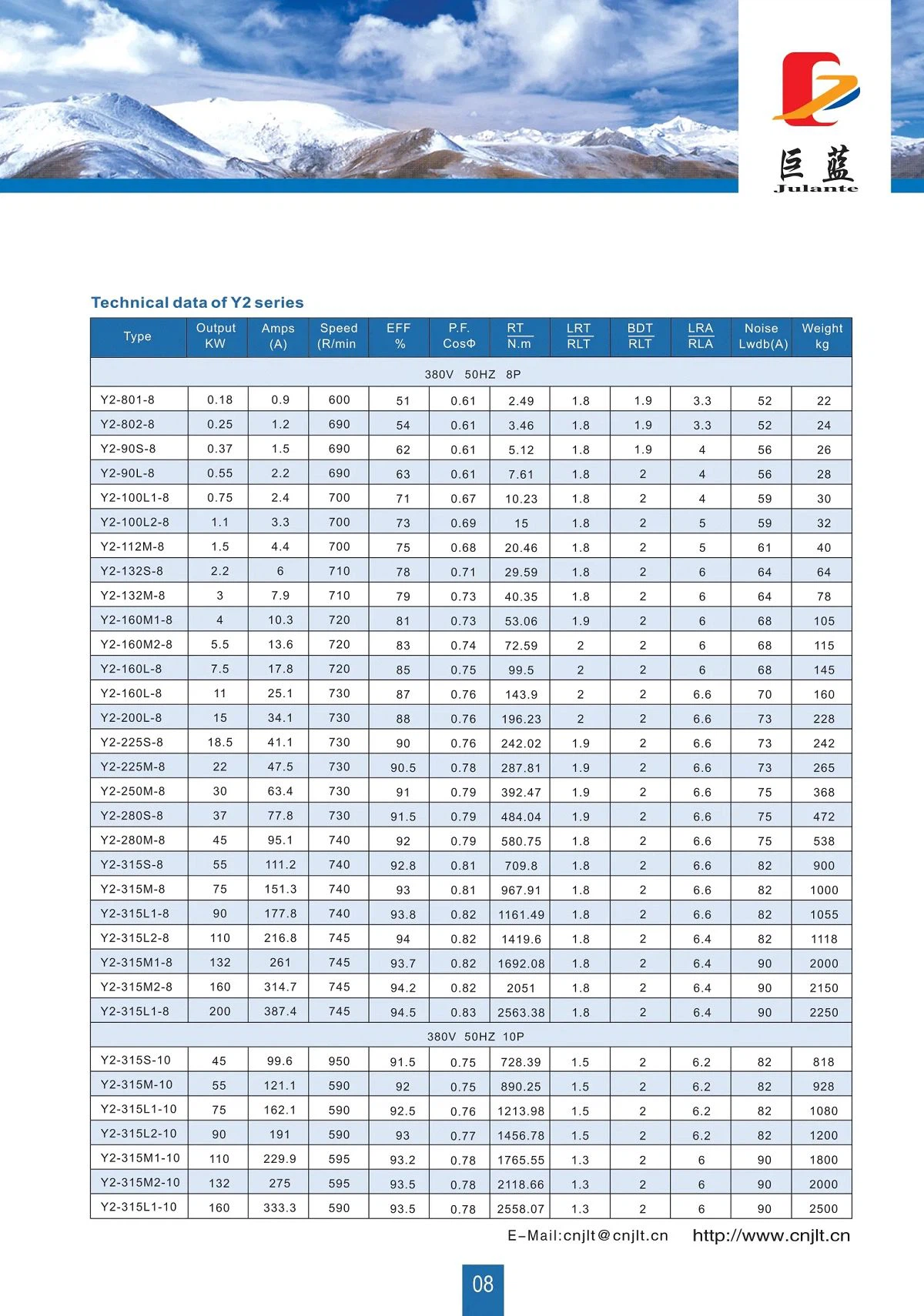
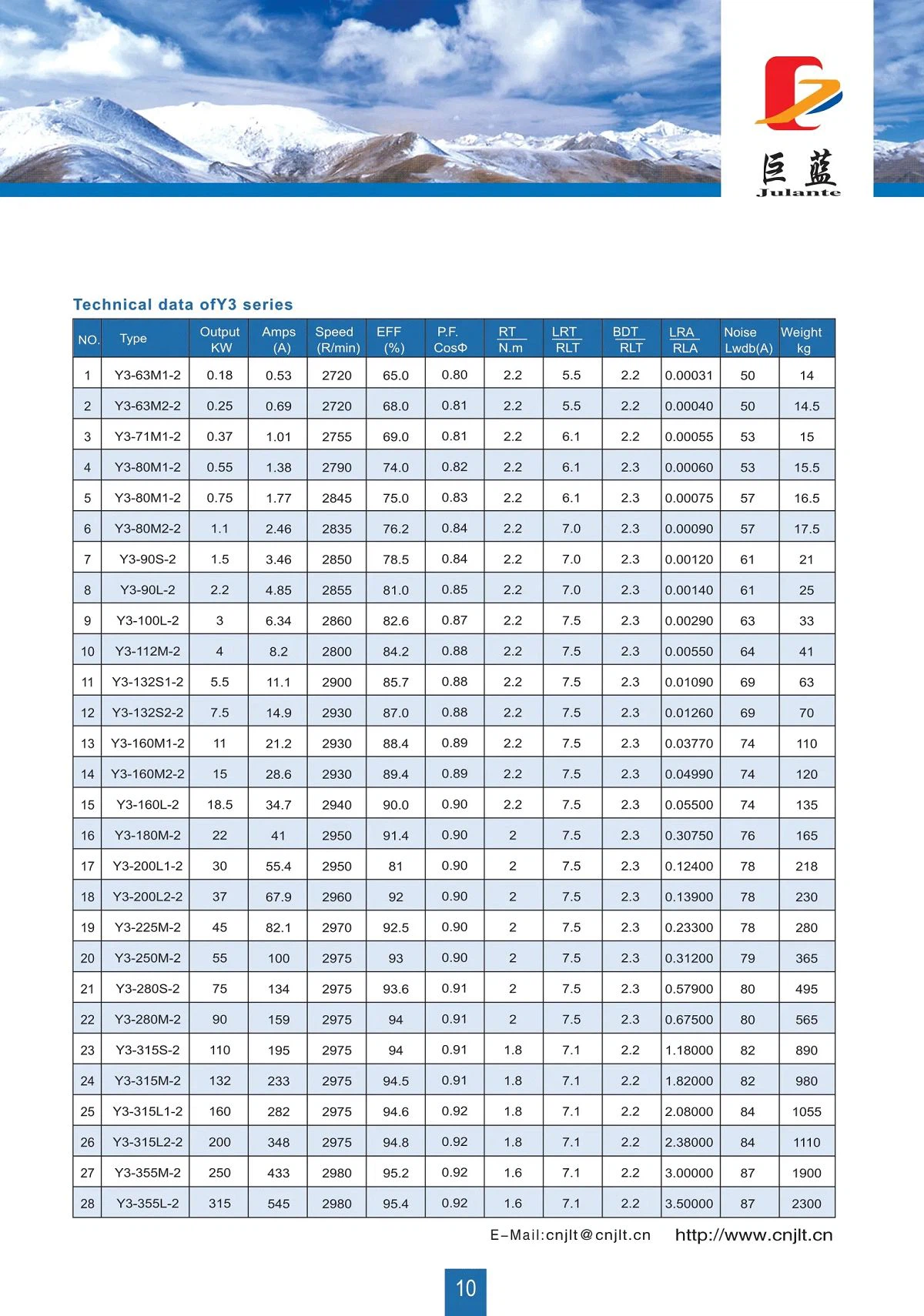
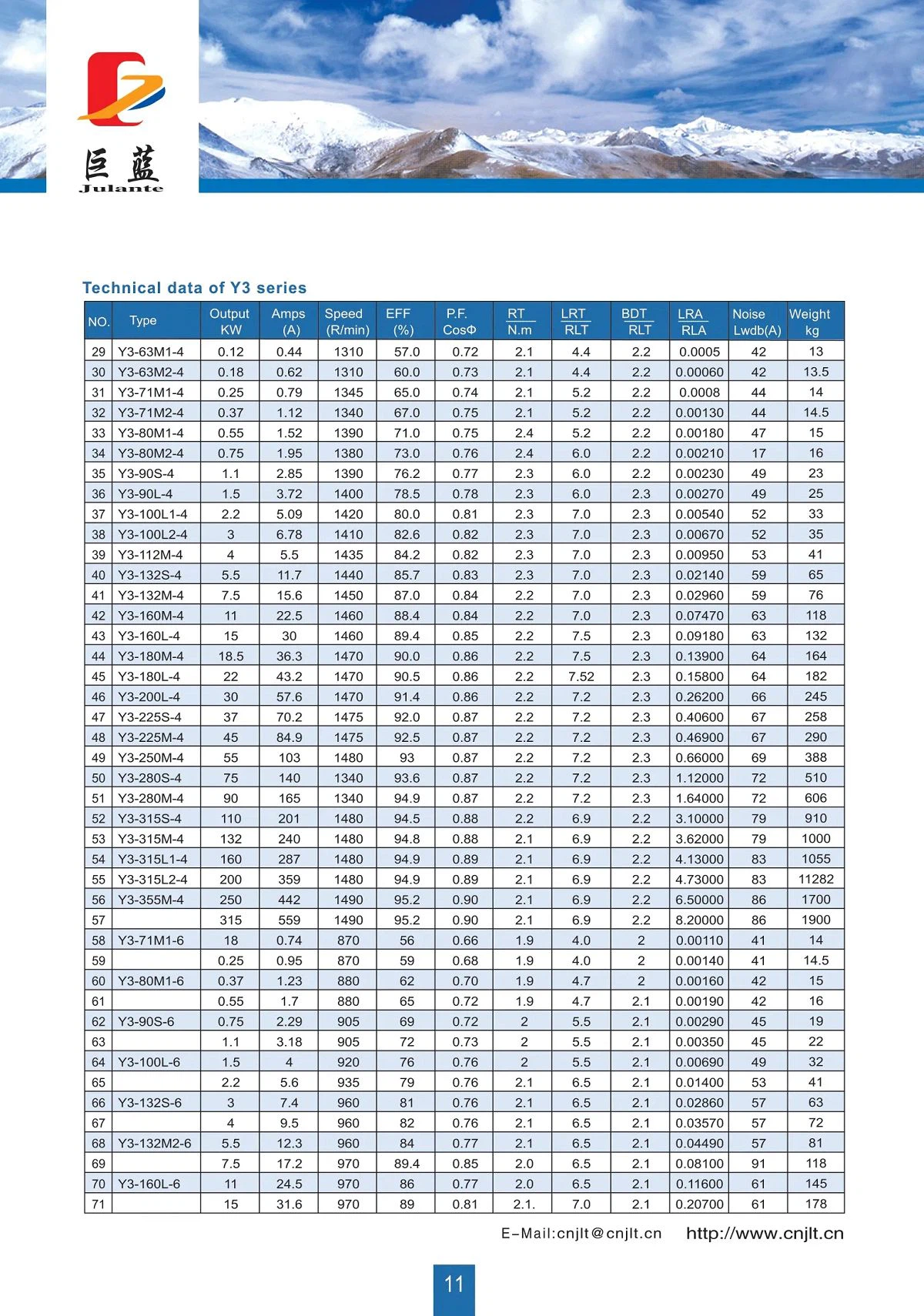
0.18KW-560KW
|
|
3
|
Voltage
|
220/380/440/660V
|
|
4
|
Speed
|
750-3000R/MIN
|
|
5
|
Wire
|
100% Copper wire
|
|
6
|
Frequency
|
50/60HZ
|
|
7
|
Protection Class
|
IP44/54/55 B/F/H
|
|
8
|
Warranty
|
1Year
|
|
9
|
-Ambient Temperature
|
-15℃≤0≤40℃
|
|
10
|
Phase
|
Three Phase
|
|
11
|
Application
|
General Machinery
|
|
12
|
Mounting Type
|
B3/B5/B35
|
|
13
|
Duty
|
S1 Continuous
|
|
14
|
Place of origin
|
Zhejiang,China
|
|
15
|
Protect Feature
|
Toally Enclosed
|
|
16
|
Model Number
|
Y/Y2/YE3/YR/YZ
|
|
17
|
Efficiency
|
IE2 IE3
|
|
18
|
Certification
|
CE CCC ISO9001
|
|
19
|
Altitude
|
Not exceed 1000m
|
|
20
|
Standard
|
Confirm to IEC international standard
|




PRODUCT CONFIGURATION

Rotor

Stator

Motor Casing
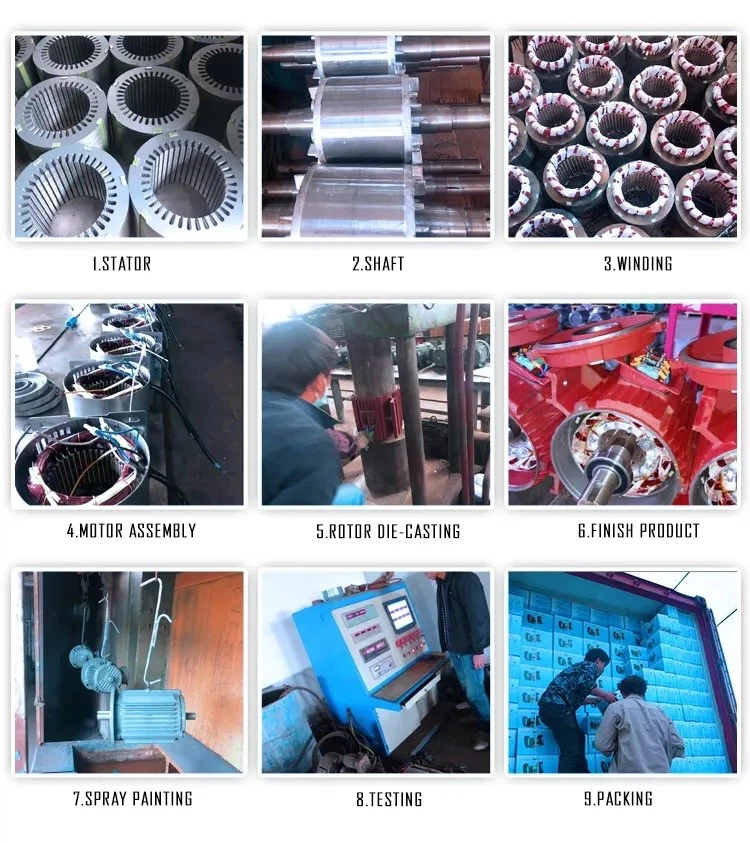

Transport


FAQ
Q: How Electric Motors Work
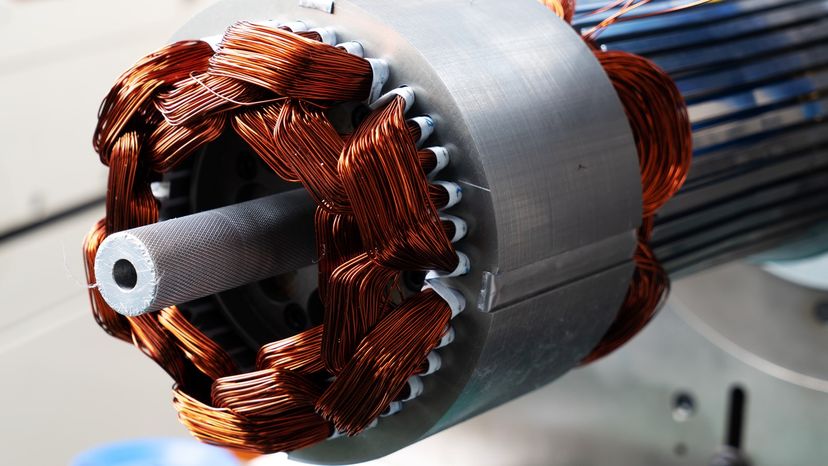 Electric motors are everywhere. DOWELL/GETTY IMAGES
Electric motors are everywhere! In your house, almost every mechanical movement that you see around you is caused by an AC (alternating current) or DC (direct current) electric motor. In this article we'll look at both types.
By understanding how a motor works you can learn a lot about magnets, electromagnets and electricity in general. An electric motor uses magnets to create motion. If you have ever played with magnets, you know about the fundamental law of all magnets: Opposites attract and likes repel.
So, if you have two bar magnets with their ends marked "north" and "south," then the north end of one magnet will attract the south end of the other. On the other hand, the north end of one magnet will repel the north end of the other (and south will repel south). Inside an electric motor, these attracting and repelling forces create rotational motion.
ContentsInside an Electric Motor
How a DC Motor Works
Toy Motor
Rotor, Commutator and Brushes
Putting It All Together
How an AC Motor Works
AC Rotor and Stator
Motors Everywhere!
Inside an Electric Motor
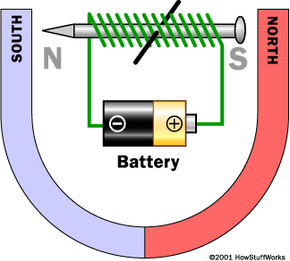 You might be surprised to find out just how much work is done by electric motors.
HOWSTUFFWORKS
To understand how an electric motor works, the key is to understand how the electromagnet works. (See How Electromagnets Work for complete details.)
An electromagnet is the basis of an electric motor. Say that you created a simple electromagnet by wrapping 100 loops of wire around a nail and connecting it to a battery. The nail would become a magnet and have a north and south pole while the battery is connected.
Now say that you take your nail electromagnet, run an axle through the middle of it and suspend it in the middle of a horseshoe magnet as shown in the illustration. If you were to attach a battery to the electromagnet so that the north end of the nail appeared as shown, the basic law of magnetism tells you what would happen: The north end of the electromagnet would be repelled from the north end of the horseshoe magnet and attracted to the south end of the horseshoe magnet. The south end of the electromagnet would be repelled in a similar way. The nail would move half a turn and then stop in the position shown.

HOWSTUFFWORKS
The key to an electric motor is to go one step further so that, at the moment that this half turn of motion completes, the field of the electromagnet flips. You flip the magnetic field by changing the direction of the electrons flowing in the wire, which means flipping the battery over. The flip causes the electromagnet to complete another half turn of motion. If the field of the electromagnet were flipped at precisely the right moment at the end of each half turn of motion, the electric motor would spin freely.
How a DC Motor Works
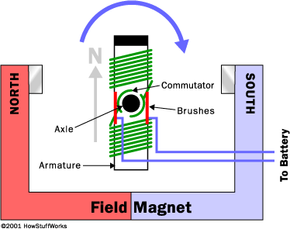 There are two magnets in the motor here: The rotor (in green) is an electromagnet, while the field magnet is a permanent magnet.
HOWSTUFFWORKS
As we mentioned, you'll encounter two types of electric motors: direct current and alternating current. The latter, direct current, or DC, motors were first developed in the mid-1800s, and they're still in use today.
A simple motor has six parts:
Stator
Rotor
Commutator
Brushes
Axle
DC power supply
The outside of a DC motor is the stator: a permanent magnet that does not move. The inside part is the rotor, which does move. The rotor here is like the nail in our previous example, and the stator is like the horseshoe magnet.
When DC power is sent through the rotor, it creates a temporary electromagnetic field that interacts with the permanent magnetic field of the stator. The commutator's job is to keep the polarity of the field flipping, which keeps the rotor rotating. This creates the torque needed to produce mechanical power.
Toy Motor
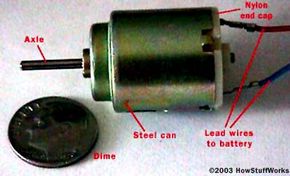 From the outside you can see the steel can that forms the body of the motor, an axle, a nylon end cap and two battery leads.
HOWSTUFFWORKS
The toy DC motor pictured is small, about as big around as a dime, with two battery leads. If you hook the battery leads of the motor up to a battery, the axle will spin. If you reverse the leads, it will spin in the opposite direction.
The nylon end cap is held in place by two tabs. Inside the end cap, the motor's brushes transfer power from the battery to the commutator as the motor spins. (Because brushes can wear out and need replacing, modern DC motors are often brushless.)
The axle holds the rotor and the commutator. The rotor is a set of electromagnets, in this case three. The armature in this motor is a set of thin metal plates stacked together, with thin copper wire coiled around each of the three poles of the rotor. The two ends of each wire (one for each pole) are attached to a terminal, and then each of the three terminals is wired to one plate of the commutator.
The final piece of any DC electric motor is the stator. In this motor, it's formed by the can itself plus two curved permanent magnets. In DC motors, the armature is the rotor, and the field is the stator.
Rotor, Commutator and Brushes
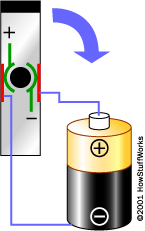 The contacts of the commutator are attached to the axle of the electromagnet, so they spin with the magnet.
As we noted earlier, the rotor is like the nail in our diagram of an electromagnet. The commutator is also attached to the axle. The commutator is simply a pair of plates attached to the axle. These plates provide the two connections for the coil of the electromagnet.
The "flipping the electric field" part of an electric motor is accomplished by two parts: the commutator and the brushes.
The diagram shows how the commutator (in green) and brushes (in red) work together to let current flow to the electromagnet, and also to flip the direction that the electrons are flowing at just the right moment. The contacts of the commutator are attached to the axle of the electromagnet, so they spin with the magnet. The brushes are just two pieces of springy metal or carbon that make contact with the contacts of the commutator.
Putting It All Together
When you put all of these parts together, what you have is a complete electric motor.
The key is that as the rotor passes through the horizontal position, the poles of the electromagnet flip. Because of the flip, the north pole of the electromagnet is always above the axle so it can repel the stator's north pole and attract the stator's south pole.
Usually the rotor will have three poles rather than the two poles as shown in this article. There are two good reasons for a motor to have three poles:
It causes the motor to have better dynamics. In a two-pole motor, if the electromagnet is at the balance point, perfectly horizontal between the two poles of the stator when the motor starts, you can imagine the rotor getting "stuck" there. That never happens in a three-pole motor.
Each time the commutator hits the point where it flips the field in a two-pole motor, the commutator shorts out the battery for a moment. This shorting wastes energy and drains the battery needlessly. A three-pole motor solves this problem as well.
It is possible to have any number of poles, depending on the size of the motor and what it needs to do.
How an AC Motor Works
Now, we're going to look at the AC motor. AC motors use alternating current instead of direct current. It shares many parts with a DC motor, and it still relies on electromagnetism and flipping magnetic fields to generate mechanical power.
The parts inside an AC motor are:
Stator
Rotor
Solid axle
Coils
Squirrel cage
The winding of the stator in an AC motor kind of does the job of the rotor of a DC motor. In this case, it's a ring of electromagnets that are paired up and energized in sequence, which creates the rotating magnetic field.
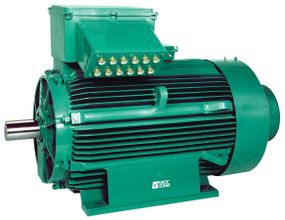 An industrial type of AC motor with the electrical terminal box at the top, the output rotating shaft on the left, and the squirrel cage covering it.
EGZON123/CC BY-SA 3.0/WIKIMEDIA
You'll remember that the rotor in a DC motor is hooked up to the battery. But the rotor in an AC motor does not have any direct connection to a power source. Nor does it have brushes. Instead, it often uses something called a squirrel cage. You read that right.
The squirrel cage in an AC motor is a set of rotor bars connected to two rings, one at either end. It's kind of like something a caged mouse (or squirrel) would run inside. The squirrel cage rotor goes inside the stator. When AC power is sent through the stator, it creates an electromagnetic field. The bars in the squirrel cage rotor are conductors, so they respond to the flipping of the stator's poles. That's how the rotor rotates, which creates its own magnetic field.
AC Rotor and Stator
The key to an AC induction motor, where the field of the rotor is induced by the field of the stator, is that the rotor is always trying to catch up. It's always looking for stasis, so it's rotating to find that steady state. But the electromagnetic field produced by the stator using AC power is always going to be a little faster than the rotor's field. The spin of the rotor is creating the torque needed to create mechanical power to turn the wheels of a car or the whirr of a fan.
Some AC motors use a wound rotor, which is wrapped with wire instead of being a squirrel cage. The squirrel cage kind is more common, though. In either case, there's only one moving part in an AC motor, which means there are fewer things that need replacing or maintenance.
Motors Everywhere!
Look around your house and you will find that it is filled with electric motors. Since our homes use AC power, most of these gadgets have AC motors. DC motors are more likely to be found in things that use batteries. Starting in the kitchen, there are motors in:
The fan over the stove and in the microwave oven
The blender
The refrigerator - Two or three in fact: one for the compressor, one for the fan inside the refrigerator, as well as one in the icemaker
The stand mixer
In the utility room, there is an electric motor in:
The dryer
The electric screwdriver
The vacuum cleaner
The electric drill
The furnace blower
Even in the bathroom, there's a motor in:
The fan
The electric toothbrush
The hair dryer
The electric razor
Your car is loaded with electric motors:
Power windows
Power seats
Fans for the heater and the radiator
Windshield wipers
The starter motor
An AC motor might power your car rather than a gasoline engine
Plus, there are motors in all sorts of other places:
Computers
Smartphones
Toys
The garage door opener
Aquarium pumps
Almost everything that moves uses an electric motor to accomplish its movement.
Now That's Powerful
You might be wondering about electric cars, which use AC motors but run on batteries, which supply DC power. The answer is easy: Electric vehicles have an extra part, called a converter, that converts the DC power from the batteries to AC power that the motor can use.
Originally Published: Apr 1, 2000
Electric Motor FAQ
How does a toy electric motor work?
A very small electric motor has two small permanent magnets, a commutator, two brushes, three poles, and an electromagnet made by winding wire around a piece of metal. It works the same way a larger version does, but on a much smaller scale.
What is a DC electric motor?
A DC electric motor converts direct current electrical energy into mechanical energy unlike the AC version that uses alternating current.
What are the parts of a simple motor?
A simple motor has six parts: an armature or rotor, a commutator, brushes, an axle, a field magnet, and a DC power supply of some kind.
How long can an electric motor last?
Under test conditions an electric motor can last between 15 to 20 years, provided it is used under normal operating conditions.
Is a DC or AC electric motor better?
AC motors are generally more powerful and require less maintenance, however, DC motors tend to be highly efficient. The application of the electric motor tends to influence whether AC or DC is selected.
Lots More Information
Related Articles
How does a brushless motor work?
How Batteries Work
How Power Windows Work
More Great Links
Simple Electric Motors
Control of Stepping Motors
Share:
ABOUT US
Taizhou Julante Electromechanical Technology Co.,LTD is a professional manufacturer of electric motor products.Have 22 years old in this business . Specialized in the production of three phase ac electric motor ,single phase ac electric motor ,internal concrete vibrator , external concrete vibrator ,air compressor ,water pump motor , Cutting machine, welding machine, grinder,ect .

Contact Us

Hot Tags: 10hp three-phase electric motor, China 10hp three-phase electric motor manufacturers, suppliers, factory, Brushless Electric Motors, Brushless Three Phase Ac Motor, Electric Ac Motors, Small Powerful Electric Ac Motors, Electric Motor for Water Pump, 10hp Electric Motor
You Might Also Like


Send Inquiry
